
ACMC is the co-secretariat of RCG, along with the United Nations Office for the Coordination of Humanitarian Affairs and the US Centre for Excellence in Disaster Management and Humanitarian Assistance.
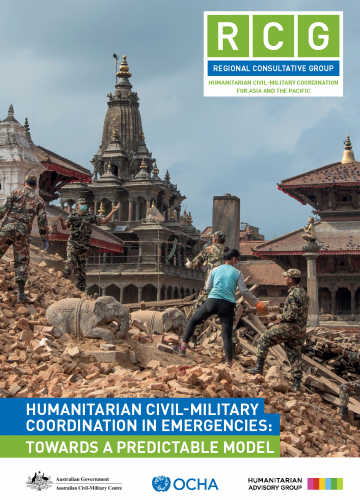
This paper discusses the need for improved understanding of the challenges and opportunities faced before outlining a study that has commenced to understand and improve interaction between NGOs and militaries.
In August 2014, the United Nations (UN) Security Council declared the Ebola virus outbreak in the West African subregion a ‘threat to international peace and security’. The UN’s request for assistance from member states resulted in the mobilisation of technical expertise, medical capacity, humanitarian assistance, and military and civil defence assets.
Responders to natural disasters face increasingly complex operating environments, characterised by new challenges and new actors. Global trends that are overwhelming the international humanitarian system come into sharp focus in South-East Asia.
The Directorate of Partnerships and Preparedness builds and fosters relationships with government and non-government stakeholders, using the work of ACMC to influence better policy and advocate for civil-military collaboration in that community.
We need the powerful outcomes generated by the United Nations Security Council’s Women, Peace and Security agenda to assist us as we reconstitute our societies and institutions, and as we resist the temptation to allow conflict to take root in the uncertainty we are all facing.