


Humanitarian action involves immediate emergency actions that address significant needs for protection, health, water, hygiene and sanitation that emerge as a result of either a conflict or disaster.
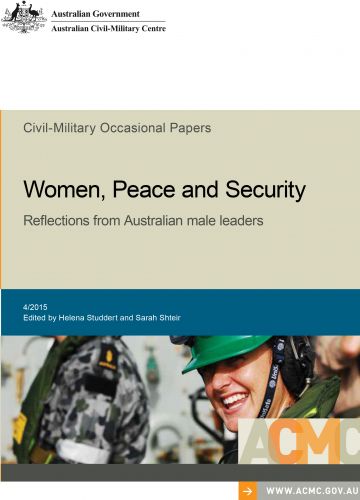
Published
Women, Peace and Security: Reflections from Australian male leaders
Moving past the theoretical by drawing together the real-life experiences, reflections and lessons of male leaders from the Australian Defence Force, the Australian Federal Police and civilians.

Published
Same Space - Different Mandates (International Edition)
A Civil-Military-Police Guide to Stakeholders in International Disaster and Conflict Response.
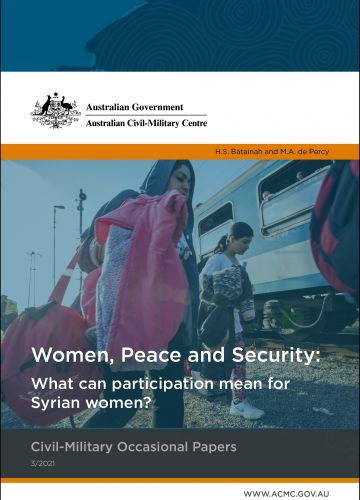
Published
Women, Peace and Security; What can participation mean for Syrian women? - Civil-Military Occasional Papers 3/2021
Between November 2018 and November 2019, the primary author conducted in-depth semi-structured interviews with 100 Syrian women in Jordan and Lebanon – host countries for large numbers of Syrian refugees (along with many Palestinian and Iraqi refugees) – and in Australia. The women were between the ages of 18 and 63; most were in their 30s and 40s. The primary author also interviewed people working with Syrian refugees in Jordan and Lebanon.
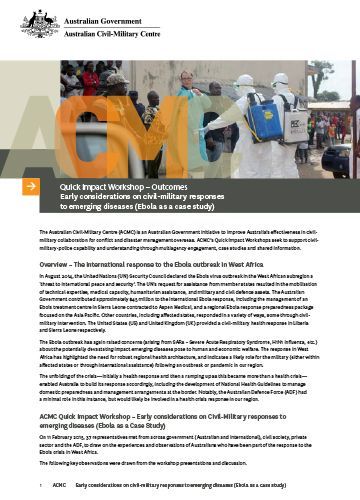
Quick Impact Workshop – Outcomes Early considerations on civil-military responses to emerging diseases - Ebola as a case study
In August 2014, the United Nations (UN) Security Council declared the Ebola virus outbreak in the West African subregion a ‘threat to international peace and security’. The UN’s request for assistance from member states resulted in the mobilisation of technical expertise, medical capacity, humanitarian assistance, and military and civil defence assets.
Published
Australian Government Guiding Principles for Civil-Military-Police Interaction in International Disaster and Conflict Management
This document affirms the principles that guide the Australian Government and its stakeholders in international multiagency response efforts. It captures the best of the learning that has come from the Australian experience of contemporary operations overseas.

Article date
ACMC is the co-secretariat of RCG, along with the United Nations Office for the Coordination of Humanitarian Affairs and the US Centre for Excellence in Disaster Management and Humanitarian Assistance.
Published
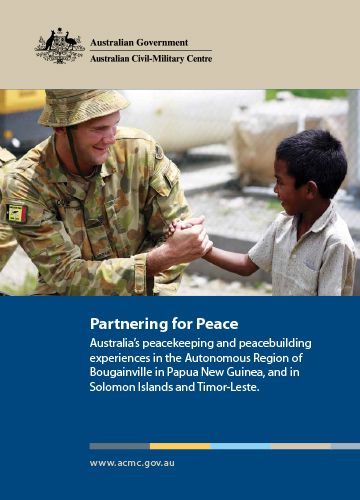
Partnering for Peace
Australia’s peacekeeping and peace-building experiences in the Autonomous Region of Bougainville in Papua New Guinea, and in Solomon Islands and Timor-Leste.

Quick Impact Workshop – Outcomes Early considerations on civil-military responses to emerging diseases (Ebola as a case study)
In August 2014, the United Nations (UN) Security Council declared the Ebola virus outbreak in the West African subregion a ‘threat to international peace and security’. The UN’s request for assistance from member states resulted in the mobilisation of technical expertise, medical capacity, humanitarian assistance, and military and civil defence assets.
Article date
The Indo-Pacific is the world’s most disaster-prone region. The increasing frequency and severity of natural disasters requires government agencies, militaries and NGOs to consider how they can better prepare and respond to crises together.