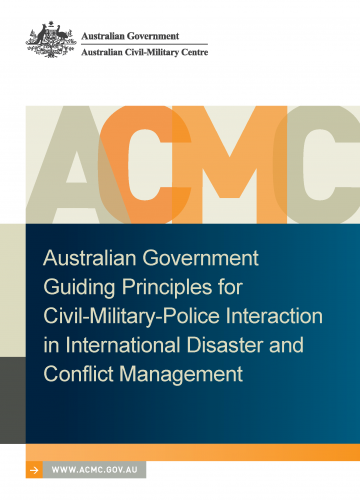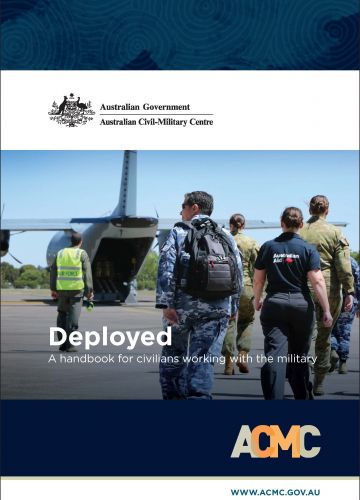

This brief publication is an introduction to the complex business of civil-military-police integration. Hopefully, you will read it prior to an exercise, not an operation. But in either case it provides good advice. Many people have gone where you are going, and this is the distillation of their experience.
This paper discusses the need for improved understanding of the challenges and opportunities faced before outlining a study that has commenced to understand and improve interaction between NGOs and militaries.
The National Action Plan sets out what Australia will do, at home and overseas, to integrate a gender perspective into its peace and security efforts, protect women and girls’ human rights, and promote their participation in conflict prevention, management and resolution. ACMC has a role in the design and implementation of this plan.
Grounded in the experience of five highly disaster-exposed countries: Fiji, Papua New Guinea, Solomon Islands, Tonga and Vanuatu, this Pacific Edition maps key civil-military coordination mechanisms at regional and national levels.
Women’s leadership and collective action have changed the world by combatting violence against women and building equality. Women’s leadership is central to reconciliation and conflict resolution and to peacebuilding efforts that bring results for families and communities.
The Directorate of Partnerships and Preparedness builds and fosters relationships with government and non-government stakeholders, using the work of ACMC to influence better policy and advocate for civil-military collaboration in that community.
The Deputy Director General position at ACMC is filled by a New Zealand Government representative. This reflects the strong historic, strategic and cultural ties between Australia and New Zealand and the requirement to work closely on civil-military-police matters.