Military

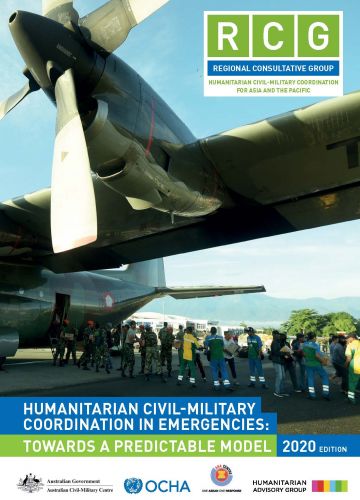
Humanitarian Civil-Military Coordination in Emergencies: Towards a Predictable Model

Humanitarian Civil-Military Coordination in Emergencies: Towards a Predictable Model

The Regional Consultative Group (RCG) on Humanitarian Civil-Military Coordination (CMCoord) for Asia and the Pacific is a key forum for supporting and elevating coordination, building relationships, and sharing learning to enhance and strengthen emergency response.
Quick Impact Workshop – Outcomes Early considerations on civil-military responses to emerging diseases (Ebola as a case study)

Quick Impact Workshop – Outcomes Early considerations on civil-military responses to emerging diseases (Ebola as a case study)

In August 2014, the United Nations (UN) Security Council declared the Ebola virus outbreak in the West African subregion a ‘threat to international peace and security’. The UN’s request for assistance from member states resulted in the mobilisation of technical expertise, medical capacity, humanitarian assistance, and military and civil defence assets.
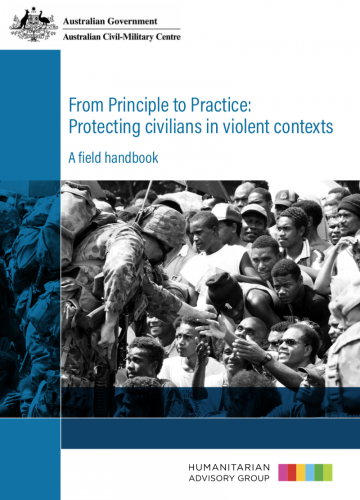
From Principle to Practice: Protecting civilians in violent contexts

From Principle to Practice: Protecting civilians in violent contexts

Lead Author/s
Following on from the ACMC Australian Guidelines for the Protection of Civilians (2015) this handbook aims to provide the ‘what’, the ‘why’ and the ‘how’ of protecting civilians in violent contexts and is intended for people working at the operational level including government, NGOs, UN and other organisations.
Civil-Military-Police Coordination in Disaster Management: Perspectives from South East Asian countries Research paper and Stakeholder Guide

Civil-Military-Police Coordination in Disaster Management: Perspectives from South East Asian countries Research paper and Stakeholder Guide

Responders to natural disasters face increasingly complex operating environments, characterised by new challenges and new actors. Global trends that are overwhelming the international humanitarian system come into sharp focus in South-East Asia.
Australian Government Guiding Principles for Civil-Military-Police Interaction in International Disaster and Conflict Management

Australian Government Guiding Principles for Civil-Military-Police Interaction in International Disaster and Conflict Management

This document affirms the principles that guide the Australian Government and its stakeholders in international multiagency response efforts. It captures the best of the learning that has come from the Australian experience of contemporary operations overseas.
Quick Impact Workshop – Outcomes Early considerations on civil-military responses to emerging diseases - Ebola as a case study

Quick Impact Workshop – Outcomes Early considerations on civil-military responses to emerging diseases - Ebola as a case study

In August 2014, the United Nations (UN) Security Council declared the Ebola virus outbreak in the West African subregion a ‘threat to international peace and security’. The UN’s request for assistance from member states resulted in the mobilisation of technical expertise, medical capacity, humanitarian assistance, and military and civil defence assets.