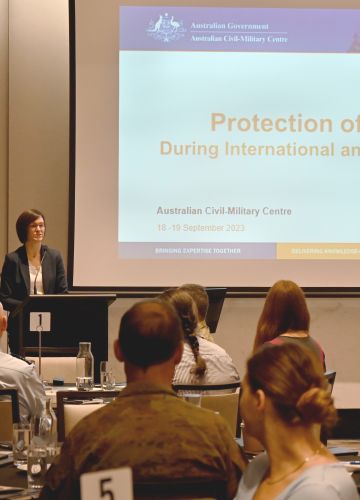

The CMPW-POC is a two-day workshop that will focus on the Protection of Civilians during international and domestic crises. With the changes in nature of
conflict, the increasing severity and frequency of sudden-onset disasters, more attention needs to be paid to understanding how government, humanitarian actors
and civil society can best protect civilians. The workshop features a series of lectures, panel discussions and activities.
The purpose of this report is to identify the lessons learned and emerging best practices of UN Member States committed to the implementation of this agenda through National Action Plans (NAPs).
The Australian Civil-Military Centre (ACMC) is following whole-of-government guidance from the Australian Department of Health and the Prime Minister’s Office in relation to COVID-19, and is monitoring the situation with a priority on the health and wellbeing of its staff and of the general community.
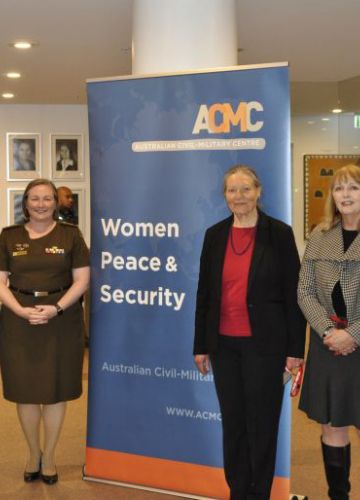
ACMC supported the Women, Peace and Security (WPS) Civil Society-Government Dialogue, in partnership with DFAT and the Australian Civil Society Coalition for WPS.
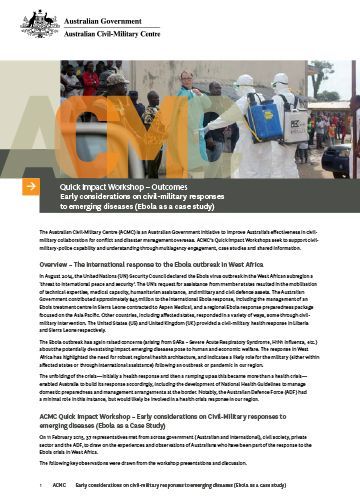
In August 2014, the United Nations (UN) Security Council declared the Ebola virus outbreak in the West African subregion a ‘threat to international peace and security’. The UN’s request for assistance from member states resulted in the mobilisation of technical expertise, medical capacity, humanitarian assistance, and military and civil defence assets.
Women’s leadership and collective action have changed the world by combatting violence against women and building equality. Women’s leadership is central to reconciliation and conflict resolution and to peacebuilding efforts that bring results for families and communities.
The United Nations’ Women, Peace and Security (WPS) agenda has emerged over the past decade and a half as a significant cross-cutting thematic program for achieving global peace and security.
We need the powerful outcomes generated by the United Nations Security Council’s Women, Peace and Security agenda to assist us as we reconstitute our societies and institutions, and as we resist the temptation to allow conflict to take root in the uncertainty we are all facing.